Write a technical report
116389

PURPOSE OF THE UNIT STANDARD
Confidently conduct a presentation in various settings ranging from a corporate wellness program to a lecture, an informal discussion or a sports team.
LEARNING ASSUMED TO BE IN PLACE AND RECOGNITION OF PRIOR LEARNING
Communication equivalent to NQF 4.
UNIT STANDARD RANGE
Guides to the scope and complexity of the specific outcomes and essential embedded knowledge are provided in bullet points beneath each. These are prefaced by “for example” since they are neither comprehensive nor necessarily appropriate to all contexts. Alternatives must however be comparable in scope and complexity. These are intended only as a general guide to scope and complexity of what is required.
SPECIFIC OUTCOME
Plan the research of a computer topic Conduct the research of a computer topic using computer technology, and to Present the results of research of a computer topic using computer technology.
SPECIFIC OUTCOME 1
Collect information for writing the report
Writing technical reports
A technical report is a document that describes the process, progress or results of technical or scientific research or the state of a technical or scientific research problem. At university, reports are read by lecturers and tutors in order to assess your mastery of the subjects and your ability to apply your knowledge to a practical task. In the workplace, they will be read by managers, clients, and the construction engineers responsible for building from your designs. The ability to produce a clear, concise, and professionally presented report is therefore a skill you will need to develop in order to succeed both at university and in your future career.
Key features of reports
Reports:
- are designed for quick and easy communication of information
- are designed for selective reading
- use sections with numbered headings and subheadings
- use figures and diagrams to convey data.
Structure
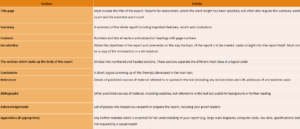
A technical report should contain the following sections
SPECIFIC OUTCOME 2
Plan the writing of the report
Planning the report
Creative phase Start by jotting down topics and ideas from your research in random order. Then, group these ideas logically and note any topics that don’t fit into groups. These might come in handy later.
Structuring the report
Use your grouped ideas to create a rough outline with headings and subheadings. This will form the backbone of your report.
Audience
As a student, your instructor might be your primary audience, but they might also ask you to write for your peers or other engineers. In the field, your audience will likely be other engineers with a similar background, but you should always consider their familiarity with engineering terminology. However, you should always evaluate who your readers will be before assuming they will understand your jargon. Consider how your readers will use your report. For instance, you might submit a technical report to a publication or your technical report may present a specific design
General format
Technical reports have an organized format because a majority of your audience may not read the entire report in one reading. This specific format allows readers to quickly locate the information they need. Most technical reports include the parts listed below.
Transmittal Letter
A business letter that provides context for the report, including project details and due dates.
Title Page
A clear, descriptive title that accurately reflects the report’s content.
The structure of a report and the purpose and contents of each section is shown below.
Abstract
A brief summary (around 150 words for an 8-page report) that gives readers an honest evaluation of the report’s content to help them decide if they need to read the entire report.
Executive Summary
A longer summary (usually 1-10 pages) that summarizes key points and conclusions for readers who don’t have time to read the entire report.
Table of Contents
A well-designed list of headings and subheadings with page numbers.
List of Figures & List of Tables
Organized lists that help readers locate graphics and tables. Typically, you can shorten a figure or table’s title when you create these lists.
Report Body
Includes an introduction, various sections, and a conclusion, with text, graphics, and lists. Always credit sources within the text.
References
A list of sources cited in the report, formatted according to your instructor’s preferred style.
Appendices
Information that’s too large to fit within the report but is necessary for understanding, such as large graphics or sample codes.
SPECIFIC OUTCOME 3
Write the report.
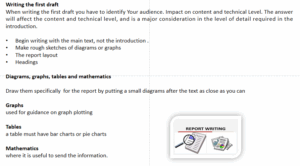
Revising the first draft
a good technical report depends on how accurately it and gives intended information on the specific reader
Use other forms of information to guide you. You must ask yourself these questions
- does your paragraph mean what you want to write?
- Are there any words that you want to remove and not affect your report?
Proofreading
the checking of every aspect of a piece of written work from the content to the layout and is an absolutely necessary part of the writing process You should acquire the habit of never sending or submitting any piece of written work, from email to course work, without at least one and preferably several processes of proofreading and it is not possible for you, as the author of a long piece of writing, to proofread accurately yourself
