115358
Apply information gathering techniques for computer system development
PURPOSE OF THE UNIT STANDARD
This unit standard is intended
- Design and conduct an interview for gathering information for computer system development.
- Design and perform an analysis of the results from a questionnaire for gathering information for computer system development
- Gather data from documents for computer system development
- Observe a person’s behaviour for gathering information for computer system development
- Consolidate the information gathered via different techniques.
LEARNING ASSUMED TO BE IN PLACE AND RECOGNITION OF PRIOR LEARNING
The credit value of this unit is based on a person having the prior knowledge and skills to:
- Demonstrate literacy skills at least at NQF level 4.
- Demonstrate PC competency skills (End-User Computing modules up to level 3).
SPECIFIC OUTCOME 1
Design and conduct an interview for gathering information for computer system development.
What is an interview?
An interview is a structured conversation where one person asks questions, and another person provides answers. It’s commonly used in various contexts, such as Job interviews, Media interviews, Academic interviews and Casual interviews. Interviews can be conducted in person, over the phone, or through video calls.
Why should you conduct interviews?
Conducting interviews is essential for gathering valuable insights, assess individuals, and make informed decisions. They allow for deeper understanding, ensuring accuracy and clarity while uncovering unique perspectives. In job settings, interviews evaluate a candidate’s skills and fit for a role. In research and journalism, they provide firsthand information. Ultimately, interviews facilitate communication, build relationships, and contribute to better decision-making.
When interviews are not the best option

Interviews may not be the best choice when objective data is required, time is limited, consistency matters, or large-scale insights are needed. In such cases, methods like surveys, data analysis, anonymous feedback, or standardized assessments may be more effective.
Types of interviews

SPECIFIC OUTCOME 2
Design and perform an analysis of the results from a questionnaire for gathering information.
Questionnaire
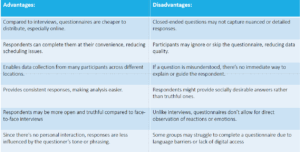
A questionnaire is a research tool used to collect information from respondents through a set of structured questions. It can be open-ended or closed-ended.
Two types of questionnaires
- Open-Ended Questionnaire: Allows respondents to answer in their own words, providing rich qualitative data.
- Closed-Ended Questionnaire: Offers multiple-choice or scale-based options, making data easier to analyze.
Questionnaire
Factors affecting the percentage of returned questionnaires
- Length of the questionnaire.
- Reputation of the sponsoring agency. Complexity of the questions asked.
- Relative importance of the study as determined by the potential respondent.
- Extent to which the respondent believes that his responses are important.
- Quality and design of the questionnaire.
- Time of year the questionnaires are sent out.
Characteristics of a good questionnaire
- Avoids complex or ambiguous wording to prevent misinterpretation.
- Begins with easy, engaging questions to encourage participation.
- Groups related questions together for a smooth flow.
- Stays brief and focused—long questionnaires may discourage respondents.
- Avoids unnecessary questions that don’t serve the study’s purpose.
- Includes both closed-ended and open-ended questions.
- Uses a clear layout with consistent fonts and spacing.
- Does not guide respondents toward a particular answer.
- Ensures topics are appropriate and relatable to respondents.
- Tested through pilot studies to check for clarity and effectiveness
SPECIFIC OUTCOME 3
Gather data from documents for computer system development.
A document analyst is responsible for reviewing, organizing, and interpreting documents to extract valuable information. Their role is crucial in ensuring accuracy, compliance, and efficiency within an organization. They assess content for errors, inconsistencies, and relevance, helping businesses streamline workflows and make informed decisions. Document analysts are often involved in system development, legal reviews, data extraction, and policy evaluation.
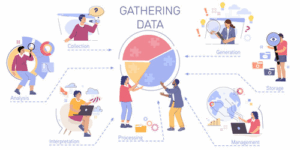
Some of the things you might do with the information you collect include
- Gathering together information from all sources and observations.
- Making photocopies of all recording forms, records, audio or video recordings, and any other collected materials, to guard against loss, accidental erasure.
- Entering narratives, numbers, and other information into a computer program, where they can be arranged and/or worked on in various ways.
- Transcribing (making an exact, word-for-word text version of) the contents of audio or video recordings.
- Coding data (translating data, particularly qualitative data that isn’t expressed in numbers, into a form that allows it to be processed by a specific software program or subjected to statistical analysis).
- Organizing data in ways that make them easier to work with.
- How you do this will depend on your research design and your evaluation questions.
- You might group observations by the dependent variable they relate to, by individuals or groups of participants, by time, by activity, etc.
SPECIFIC OUTCOME 4
Observe a person’s behaviour for gathering information for computer system development
A-B-C data is a method used to observe and analyze behavior by breaking it down into three components
- Antecedent (A): he events, action, or circumstances that occur before a behavior.
- Behavior (B): The behavior.
- Consequence (C): The action or response that follows the behavior.
This table presenting an example of A-B-C data

SPECIFIC OUTCOME 5
Consolidate the information gathered via different techniques
Which Technique to Apply?
Which technique to apply depends on a number of factors, such as
- Availability and location of stakeholders
- Development team knowledge of the problem domain
- Customers’ and users’ knowledge of the problem domain
- Customers’ and users’ knowledge of the development process and methods
Information consolidation
Information consolidation involves gathering and organizing data from multiple sources into a structured format for analysis and decision-making. It ensures clarity, accuracy, and efficiency by eliminating redundancy and identifying key insights.
Steps in Information Consolidation
- Collect Data – Gather information from interviews, questionnaires, observations, and documents.
- Organize & Categorize – Sort data into relevant sections for easier comparison.
- Analyze for Patterns – Identify trends, gaps, and inconsistencies across sources.
- Validate & Cross-Check – Ensure accuracy by comparing different inputs.
- Summarize Key Findings – Present main insights in a clear, structured format.
- Apply Information – Use findings for decision-making, strategy development, or system improvement.