1.1 The demonstrated ability to make decisions and consider options when:
Regardless of the kind of business you’re in, there will come a time when you will need to write a business report detailing your company’s current situation and establishing a plan to meet future goals. This report may be simple and short or it can be long and detailed, depending on the company’s needs and requirements. Use these general tips to learn how to write a business report and then customize the information to fit all your needs.
Writing Your Own Business Report
1 Determine your report’s audience and purpose. If the report is for your board of directors, the report should contain more information than if it’s directed toward employees who work within your division. Consider the information that is pertinent to who will be reading the report and don’t include data that is unnecessary. Your purpose and intentions of the report should be detailed at the very beginning of it.
Assess the current status quo.Provide information about how your company is handling the current situation and what its position is on the issue at hand. Include any details you have about the process of doing business pertaining to the purpose of your report.
3 Collect data. Performance reports, production numbers, quality control information, attendance reports and expenses are all important pieces of data that might be included in a business report. Depending on your report’s purpose, different pieces of data may need to be included. Carefully consider what is important to the mission of your report.
4 Format your data so it’s easy to understand. This may mean that you should create a graph or a chart displaying quantitative data. Use color within the display, as it draws more attention and helps to differentiate the information. If it’s quantitative data you’re trying to include, set it up with bullet points, numbers or in a box. This sets your data apart from the rest of your report and helps to indicate its significance.
5 Set goals within your report. Clearly specify what your expectations are for the future. The goals should be measurable. Perhaps, you wish that production would increase. Set a goal for a 20 percent increase in production and set a deadline when that goal will be measured.
6 Establish a plan to meet the specified goals in the report. Goals should include specific actions, not vague statements. Write out any changes in job descriptions, schedules or expenses necessary to implement the new plan. Each statement should directly indicate how the new method will help to meet the goal set forth in the report.
7 Print enough copies to distribute to everyone in the meeting where you will present the report. If there are several pages, bind them together. Include all necessary attachments and additional documents.
Recipients of various reports
In business, the information provided in reports needs to be easy to find, and written in such a way that the client can understand it. This is one reason why reports are divided into sections clearly labelled with headings and sub-headings. Technical information which would clutter the body of the report is placed in the appendix.
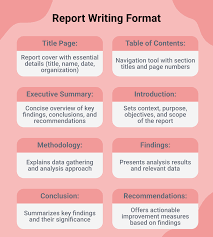
The structure of a report and the purpose and contents of each section is shown below.
|
TITLE PAGE |
Report title |
|
EXECUTIVE SUMMARY |
overview of subject matter |
|
TABLE OF CONTENTS |
list of numbered sections in report and their page numbers |
|
INTRODUCTION |
terms of reference |
|
BODY |
Headings and sub-headings which reflect the contents of each section. Includes information on method of data collection (if applicable), the findings of the report and discussion of findings in light of theory |
|
CONCLUSION |
states the major inferences that can be drawn from the discussion |
|
REFERENCE LIST |
list of reference material consulted during research for report |
|
APPENDIX |
information that supports your analysis but is not essential to its explanation |
1.2 Report writing strategies that you can use
When you are writing a good report style response you will find that you are placing less emphasis on traditional formal essay techniques. Reports, in contrast, feature carefully constructed introductions, detailed bodies and logical conclusions.
Components of business reports
- short preview or overview statements
- shorter than “traditional essay paragraphs” that “get right to the point”
- lists of main points, as in the previous sample reports, followed by expanded descriptions where appropriate
- headings to draw attention to major points or new sections
- selective underlining or highlighting where emphasis is required
- inclusions where possible of graphs, tables and diagrams
- expression and justification of your own point of view and
- Strong but condensed conclusions with recommendations for action where called for.
One disadvantage of report style writing can be that some students tend to write only an outline. Avoid that trap. So, instead of being a concise “report”, the presentation becomes nothing more than a series of short points lacking depth, explanation and substantial conclusions or recommendations for action.
Student exercises in report writing
Write about an A4 page (around 250 words) on either or both of the following. Incorporate a few report format techniques, and then seek an opinion from your FACILITATOR
- Report on a successful business you have dealt with in your community. From what you know about the business, discuss what factors you think may have contributed to the success of the business over the years.
- Describe how you would explain the term “business” to another senior non Business Studies student who has asked you “What is business?”
1.3 Investigative reporting, writing techniques
|
|
|
________________________________________________________ Investigative reporters must take special care when writing a story. This is because investigative stories usually make someone appear either bad or stupid, accusations which can lead to legal action against you for defamation. You will probably be safe if your story is true and in the public interest. But it can lose the protection of the law if there are serious errors. Someone – probably the people your story exposes as corrupt, dishonest or simply incompetent – will be looking closely for mistakes to attack you on. So you must take extra care. (For more on the risks of defamation, see Chapter 69: Defamation.) Writing Writing stories or scripts based on investigative journalism requires all the skills you need for general journalism. However, given the risks you will face in investigative journalism, a few of the core rules are worth stressing again here: Stick to facts You will be much safer if you stick to facts which you can prove are true. That is why you check your facts and get confirmation for each one. As you write, stop at each new important fact and say to yourself: “Is this true?” Then say: “Have I confirmed it with another source?” Do not speculate (i.e. write things which might be true, but which you cannot prove). If you do not have all the facts you would like, you may have to be satisfied with a lesser story, as long as it makes sense and contains no errors. Avoid personal comment Do not put in your personal opinions. You may be writing a story about someone who has cheated old people out of their life savings. You may hate this man, but you must not say it. You might believe he is evil, but you should not say that either. If you show in your story that you hate this man, that could be seen as malice, which will destroy your defence against defamation. Just show your readers and listeners the facts. If the man is bad, the facts will lead your audience to that conclusion without you telling them what to think. Keep your language simple Keep your sentences short and your language simple and concise. Some investigations will reveal some very complicated facts, perhaps because the person under suspicion has tried very cleverly to hide their wrongdoing. You must simplify this for your readers or listeners, so they get a clear picture of what has happened. Avoid vague words Wherever possible, avoid using vague words, such as “a large amount” or “some time later”. Words like this show that you do not have accurate details – otherwise you would use them. Sometimes this is unavoidable, but vague words will usually take the strength out of a story. If you know the man cheated the old people out of $110,854, write that figure somewhere in the story (but not, obviously, in the first few paragraphs, where you should say “more than $100,000”). Check your work You should check your work at each stage and when you have finished, double check everything again. Ask yourself again: “Are these facts correct and confirmed?” If you have enough time, put the story to one side for a few hours, then return to it with a fresh view, seeing it as a reader or listener might. Ask a colleague to read the story and try to find errors. Do not be upset if they expose errors or big gaps in information. It is better to be told now by a colleague than later in a defamation case. Wherever possible, show the story to your organisation’s lawyer, who will bring a fresh mind to the story and spot any legal problems which might arise. If anyone recommends changes, do not let them write the changes themselves. They will not know the case as well as you do. Get them to explain what is wrong, rewrite that part yourself, then ask if it is right. Never settle for anything you are not completely happy with. One final check worth making is to ask yourself: “Is there any way I have identified my confidential sources, even though I promised to keep them secret?” Try to read the story as if you are one of the people who has been accused of incompetence or corruption. See if they would be able to identify any of your confidential sources from what you have written. If there is any risk at all, change the story to protect your sources. Illustrations Can you use any illustrations to make your story more interesting? Perhaps you can use pictures of the victims looking sad, or someone at the scene of an alleged crime. In complicated stories, a diagram might help to show how the pieces fit together. For example, in a story involving related companies, you should include a simple box diagram showing with lines and arrows how the companies are related. If your organisation has a graphic artist, ask them for help. In a story about how a government department has been wasting taxpayers’ money, you might use a graph to show how the money has disappeared over the years. If you have a really important document to support your story, include the relevant sections of that document as an illustration. On television, you can type quotations from the document across the screen as the story is being read out. On radio and television, use the actual tapes of interviews if you have them. These will add variety and also act as confirmation. However, if your interviewee wants to remain anonymous, perhaps film them in silhouette or change the sound of their voice electronically. Headlines However carefully you write your story to make it safe, a sub-editor may not understand exactly why you use certain words or describe something in a certain way. The sub-editor may write a headline which is wrong or possible defamatory. Having spent a lot of time working on the story, do not abandon it at this final stage. Discuss possible headlines with the sub-editor, until both of you are satisfied you have done the best job possible. Some words of warning As we have said several times in these chapters, there are many dangers to investigative reporting. The greatest danger is that you will do or write something which will allow the person under suspicion to take you to court for defamation or on some other charge. So remember the following: Sub judice reporting It may happen that a story you are investigating is also being dealt with by a court. In most countries, a matter before a court is said to be sub judice and there are limits on what can be reported about it, beyond what is said in the court. Be very careful when covering any sub judice matters. Consult your editor or lawyer for advice. If you make the wrong decision, you could be charged with contempt of court. Mistakes If someone complains about a mistake after the story is published or broadcast, never issue an immediate apology or correction without talking first to your editor and lawyer. They will decide what action to take. Payments for stories Sometimes people will ask to be paid for their information. Try to avoid this, but sometimes it is necessary, even if it is a few dollars for a tip-off. However, never pay for something which might have involved criminal activity. For example, if someone asks for $100 to provide a document, then they steal that document, you could be charged as an accomplice to theft. Any payment could be seen as encouraging a crime. Concealing crimes Your informant may tell you that they have committed a crime, perhaps that they broke into an office to steal a photograph as proof of corruption. You should never knowingly hide a criminal from the law. If you think that your informant is involved in criminal activities, tell them at the beginning that you do not wish to know anything about it. Talk only about the facts you need to know for your story. A final warning You may live in a country where the media are controlled and the government will not allow any real investigative reporting. You and your editor must decide whether or not you should take the risk of carrying out investigative reporting which the government will not like, and may punish you for. But journalists throughout the world have often had to make such decisions. Some have paid the price with imprisonment or death. You must decide in each case whether the issue is worth the risk. |
1.4 Examples of Business Management Reports
Small companies use many business management reports to monitor the success of their businesses and operations. These reports may include financial, labor and traffic reports, as well as detailed information about customers. Directors, managers and analysts of various departments are usually responsible for writing these reports. However, these business professionals typically share their reports with other managers and employees to keep them well-informed.
Profit and Loss Reports
Financial managers and accountants usually write and produce profit and loss reports. These reports are also called income statements. Financial professionals usually write these reports to outline the gross sales each month, quarter or year. Expenses such as product orders, promotions and employee wages are also included in these reports. Expenses are then deducted to calculate net profits. Profit and loss reports are used to study cyclical sales patterns, such as when sales peak each year. Managers also establish their advertising and inventory budgets with these reports.
Labor Reports
Labor reports are used to outline various labor expenses, including salary and health benefits. Some types of labor reports are highly detailed. For example, plant managers often study labor reports to determine if their wages are in line with industry averages. Similarly, restaurant managers may use labor reports to determine how many workers should run lunch and dinner shifts. Labor is usually the largest business expense, according to Bloomberg BusinessWeek. Hence, these reports are vital to all organizations.
Web Traffic Reports
Online businesses or companies with websites often use web traffic reports. Some important details garnered from these reports include page views, unique visitors and referrers. Website referrers are search engines from which web traffic is generated, according to “Entrepreneur” online. These search engines typically include Google, MSN, Yahoo, Lycos and other major search engines. Companies also use web traffic reports to determine how long visitors spend on various pages. Managers can also study what time of day most of their customer traffic is generated.
Customer Survey Reports
Marketing research professionals often conduct customer surveys by phone, mail and the Internet. These surveys are used to measure customers’ satisfaction with a company’s products and services. Small business owners may also use them to determine which product features are most important to customers. Marketing research managers then analyze the survey data and highlight key findings from the surveys in their reports. Top management may then use the customer survey report to develop various marketing strategies.
1.5 Examples of Business and Financial Reports
A company’s often-diverse business activities, combined with changing marketplace characteristics, frequently make it difficult to create an accurate picture of the business’s financial and operational health. The business’s managers may find it especially difficult to move beyond day-to-day operations to obtain a larger picture of the company’s status. Structured reports help provide this information so the business can make decisions about financing, investment, market expansion and other business opportunities.
Competitive Analysis
A company’s competitive analysis provides a snapshot of the business compared with its marketplace competitors. The table-format analysis targets identifiable factors such as products, sales strategies, credit practices and advertising. The competitive analysis also names conceptual variables, such as company reputation, reliability and appearance. Designate each factor as a strength or weakness for your business and evaluate the same factor for your competitors. Cumulatively, this data provides a multifaceted picture of your marketplace’s players. The analysis enables you to identify your areas of excellence as well as functions that would benefit from improvement.
Cash Flow Statements
A business’s cash flow represents its lifeblood, as the cash flow reflects the company’s sources and uses of its funds over a specified time period. The cash flow statement shows net receipts from general business operations, such as cash sales to customers. Employee salaries and supplier payments also contribute to operational cash flow data. Net cash flow from external financing activities, such as common stock sales and loan term changes, represents another important component. Net cash flow from equipment acquisition or sale reflects a firm’s optional investment activities. The firm compares the net change in marketable securities and cash, cumulatively caused by variance in other statement components over a certain time period, to verify that the figures match the cash change figures on the balance sheet for the same period.
Balance Sheets
A company’s balance sheet lists the business’s aggregate asset dollars. Common assets include company-owned equipment, inventory, vehicles and cash on hand. Assets also include intangible components, such as product trademarks and registered patents. In contrast, liabilities show a company’s cumulative indebtedness to other entities. Examples include bank loans, building rent and tax expenses. Shareholders’ equity, also called owners’ equity, represents the dollar value that would remain after the business sold its assets to retire its liabilities. In general accounting terms, total assets’ value must equal the sum total of the liabilities and shareholders’ equity.
Annual Reports
Companies publish and distribute annual reports that summarize the prior year’s business climate, company operational results and projections for the following year. Annual reports typically include industry descriptions and discussion of the company’s operations segments. Independently audited financial statements, along with management’s statement analysis and posting of the previous two years’ statement results, help to round out the annual report. Since 1934, the United States Securities and Exchange Commission has required publicly owned companies to file annual reports. For-profit and nonprofit firms file these reports regularly.
1.6 Business Report Example
A business report, which is also known as a formal report, is a data compilation, a short account, or a plan, or even summarized minutes of a certain meeting. Such a business report is basically a way communicating logically summarized and formatted information to associates, superiors, or subordinates.
Advertisement
The term business report is very broad, and its scope extends up to almost all reports that are formally written to fulfill some or the other business motive or objective. Technically, you can write a business report even on a small discussion you had with your boss.
Features
The report has a specified objective, motive, or aim, such as a proposition, proposal, or simply a general report. Rationality is the second most important feature of a business report. The facts that have been included in the report need to be backed by a rational figure or logical thought. It can never be abstract. Thirdly, time frame is a crucial feature, as the time frame of execution of tasks needs to be included in the report. Lastly, a backup plan is also needed to restore the original targets, as there is always a high probability that the original plan may not be completely executed. Lastly, you can also include a protocol for the same, which can include definitions, internal norms, and rules, in relation to the report.
Thus, to sum up, a business report should be an A.R.T.B.P (aim, rationality, time-frame, backup plan and protocol), so that it becomes a success.
Features
There are approximately 10 elements of a business report. These segments are basically set in such a manner that they fulfill the aforementioned features of the report. It is a convention that usually one element is included on one page or a couple of pages, depending upon the size of the report.
Title of the Report
Letter of Transmittal
Table of Contents
Summary/Synopsis
Introduction: Main content
Discussion of the main content
Conclusions drawn
Recommendations
Bibliography/Source
Appendices
These elements have been explained in an example provided below that will help better illustrate the point.
Sample Report
Now, note that, this business report is just an example, and is thus quite short and simple. In reality, an actual report is much longer and also tends to provide much more precise and intricate information.
Report on Eco-Homes Project
- Title of Business Report
Title: Eco-Homes Project Initiative
Objective: Compile data and analysis for development for housing project Eco-Homes at location and address of the project.
Report by: Dr. Larry Marshall, CEO EcoVision Projects, Empire Construction and Infrastructure Group.
Key Contents: A Detailed plan, proposition, execution schedule and analysis of the project idea of an eco-friendly settlement put forth by Dr. Jason Smith, New Projects Department, Empire Construction and Infrastructure Group (mother company).
Reporting and Analysis Time: 1 month
Project Implementation Time: 17 months
Assumptions: The time frame and execution is framed, taking into consideration the seasonal elements of climate and other turnover ratios, experienced in the previous financial year.
- Letter of transmittal
Attached, letter of transmittal, conveying the idea by Dr Smith, consisting of the core features of report.
- Table of Contents
Summary and Synopsis of the Project
Introduction
Discussion and Details
Conclusion
Recommendations
- Summary and Synopsis
The Eco-Homes Project Initiative is an underway project which has been conceived by the Empire Group. The basic ideology of the initiative is eco-friendly living. The Empire group intends to build a mega residential complex which is spread over 35 acres of land, and house around about 150 households, which are self-sufficient in several ways. The complex thrives on the basis of inbuilt agricultural center, animal husbandry center, building gardens, fuel cell and bio-gas-propane generators of electricity, massive solar panels which provide heat to the homes and also electricity. The complex will span over the 35 acre premise and will consist of 3 core residential centers 15 solar panel driven green houses, 2 orchards, 5 gardens, 3 pastures and 3 animal husbandry centers cum dairies and a staff of 33 people.
- Discussion and Details
Some common points, details and conclusions that were drawn in the meeting of project engineers, company architects, cost accountants and the CFA’s go as follows. The project will bring a substantial revenue if all 150 houses are sold off at a price of amount per house hold. The project will be a highly big commercial success as it is not just situated in the city but, once the customer buys the housing facility his usual bills that include, electricity and water bill will be cut down to half. The only con that is foreseen is that the sale value is huge.
There are 5 phases of the project, namely, the basic foundation phase, housing complex 1 phase, followed by 2 and 3, with the last phase being the development of all the support and infrastructure facility. It is estimated that every phase would go on for 3 months plus a backup of 2 months has been provided.
The sales for real estate would begin with the completion of housing complex 1, followed by complex 2 and 3. By the end of complex 3, the real estate market rates would have increased by 7.8%. This price escalation however is not included in any of the calculations.
The cost sheets showing cost projections for the project have been attached.
A 5 year maintenance, free of cost has been provided for the complex. An operation cost of about $500 per 2 months is to be paid by every household to keep the operations going.
- Conclusion
The project team recommends that this project should be taken up and executed as fast as possible as the real estate market is and the eco-friendly products have been consistently showing positive rises in the past 5 years.
- Recommendation
In order to reduce operational cost of $500 for every two months, which is incurred by the residents, the project team recommends more research and development. It a selling point that can be put forth to boost sales.